In the musical ‘Cabaret’ Fred Ebb first reveals the famous phrase ‘Money makes the world go round.’ This outlook is still as relevant in today’s society as it was in the musical’s first production in 1966.
The importance of money can be seen everywhere in society. Everyone needs money to pay for living expenses, businesses use money in everything they do, and a vital cog in the wheel of a successful government is a healthy economy.
A central component to the EU’s success is an economic environment where each country is achieving sustainable stability and growth. As the EU is united by a common currency, the state of one country’s economy and the decisions that they make affect the other countries in the Eurozone.
Sustainability is the most important part of growth. In times of natural disasters, emergency aid is often given to countries, to fix the short term problem. However, this does very little to resolve the larger issue going into the future, as the aid is not sustainable.
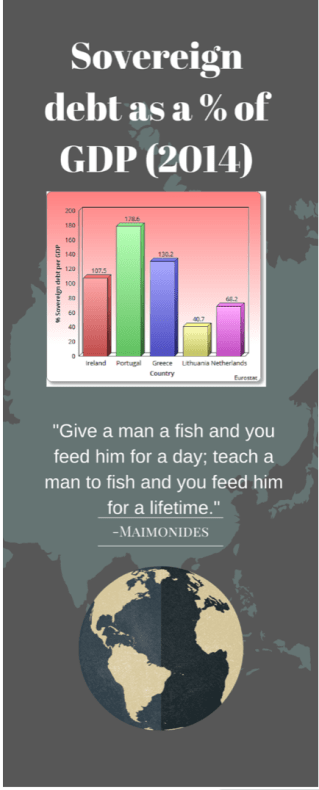
Another example of this is evident from the economic downturn in 2008. Ireland, Portugal and Greece sought aid from the European Financial Stability Facility (EFSF), a temporary crisis resolution measure. However, it soon became clear that in the long run, this plan would do these countries more harm than good. It was quickly replaced with the European Stability Mechanism (ESM), which is a more controlled and planned approach which would ultimately help these countries to not only escape recession, but more importantly to recover from it.
The effects of this poor planning and lack of foresight is glaringly obvious when faced with the sovereign debt statistics for these three countries, as shown in the chart. The fact that they are three of the five highest countries for sovereign debt as a percentage of GDP, and that they all used the EFSF is no coincidence.
This is a clear indicator that for economic integration in the EU, EU lawmakers must strive for policies that ensure controlled and planned stability, where the foundations laid are strong enough to avoid having a detrimental effect on the economy of countries in years to come.
It is of paramount importance that the need for stability is recognised, that we do not repeat previous mistakes, and that economic policies are designed to create an equal Europe for small and large nations alike.

Niall McManus (IE)
 CONNAUGHT ULSTER 2015